

The shower is the most-used fixture in any bathroom — and in a luxury home, it deserves to be the most considered. When Calacatta marble wraps every surface, when frameless glass disappears and the stone reads as a continuous room within a room, and when gold hardware catches light against white veined stone — the daily ritual of bathing becomes something closer to ceremony.
This project showcases one of the most technically precise shower installations Atlantic Construction & Remodeling has completed. A neo-angle frameless enclosure in a corner position, Calacatta marble wall tile book-matched on the feature wall, basket weave mosaic on the floor, a gold rain head recessed into the ceiling, and a built-in bench that doubles as a design moment — every element resolved with the same care as the most visible room in the house.
Understanding why frameless glass works so differently from other enclosure types, how marble tile patterns interact with glass clarity, and how gold versus brushed nickel hardware changes the entire emotional register of a shower — these are the decisions that separate a luxury result from a merely expensive one.
The glass enclosure type is not an aesthetic choice alone — it is a structural and material decision that determines how the shower reads in the room, how easy it is to clean, and how long it will look new. Each of the three major enclosure types serves a different market, and understanding the differences is essential before specifying anything.
Framed enclosures use a continuous aluminum frame around every panel and door — top, bottom, sides, and the door meeting stile. The frame provides structural rigidity at low cost and allows the use of thinner, lighter glass (typically 3/16 inch). The trade-off is visual: the frame creates a grid of metal around the shower that interrupts the view of the tile behind it and dates quickly as metal finishes change.
Semi-frameless enclosures eliminate the frame around fixed panels but retain the door frame and threshold. This is a meaningful improvement in transparency over fully framed, and it allows slightly thicker glass. The door stile and hinges are heavier hardware that reads more distinctly in the room. Semi-frameless is the most common upgrade tier in production builder bathrooms and represents a reasonable compromise at mid-range price points.
Fully frameless enclosures eliminate all metal framing except for the hinges, handle, and minimal U-channel or clamps where glass meets wall or floor. This requires 3/8-inch or 1/2-inch tempered glass that is structural in its own right. The result is a glass plane so clean that it essentially disappears — and the tile behind it reads without interruption. For any shower where the tile is the design statement, frameless is the only correct choice.
“Frameless glass doesn’t just look cleaner — it changes the geometry of the room. The shower stops being a box inside the bathroom and starts being part of the bathroom itself.”
The floor plan of the bathroom determines which shower configuration is appropriate. Each configuration has different implications for the glass panel count, door swing, cleaning effort, and visual presence in the room.
A walk-in shower with a single return panel — one glass panel perpendicular to the opening to contain water — is the most minimal configuration. It works best when the shower is large enough (typically 48 inches minimum in the entry dimension) that the opening can remain partially unenclosed without creating a water containment problem. Walk-in configurations feel the most open and are the easiest to clean.
A corner shower uses two fixed panels and a door to enclose a rectangular or square footprint in the corner of the room. This is the most common configuration in master bathrooms because it uses the corner efficiently and allows a generous interior footprint even in rooms that are not oversized. The frameless corner shower in this project is a 48×36 inch footprint with a hinged door on the long dimension.
A neo-angle shower cuts across the corner of the room at 45 degrees, using a diagonal door panel flanked by two angled fixed panels. Neo-angle configurations use less floor space than a full corner enclosure and add visual interest because the diagonal line moves dynamically in the room. The glass count is higher and the installation is more complex, which makes this configuration more expensive — but in the right bathroom, it is the most architecturally engaging option.
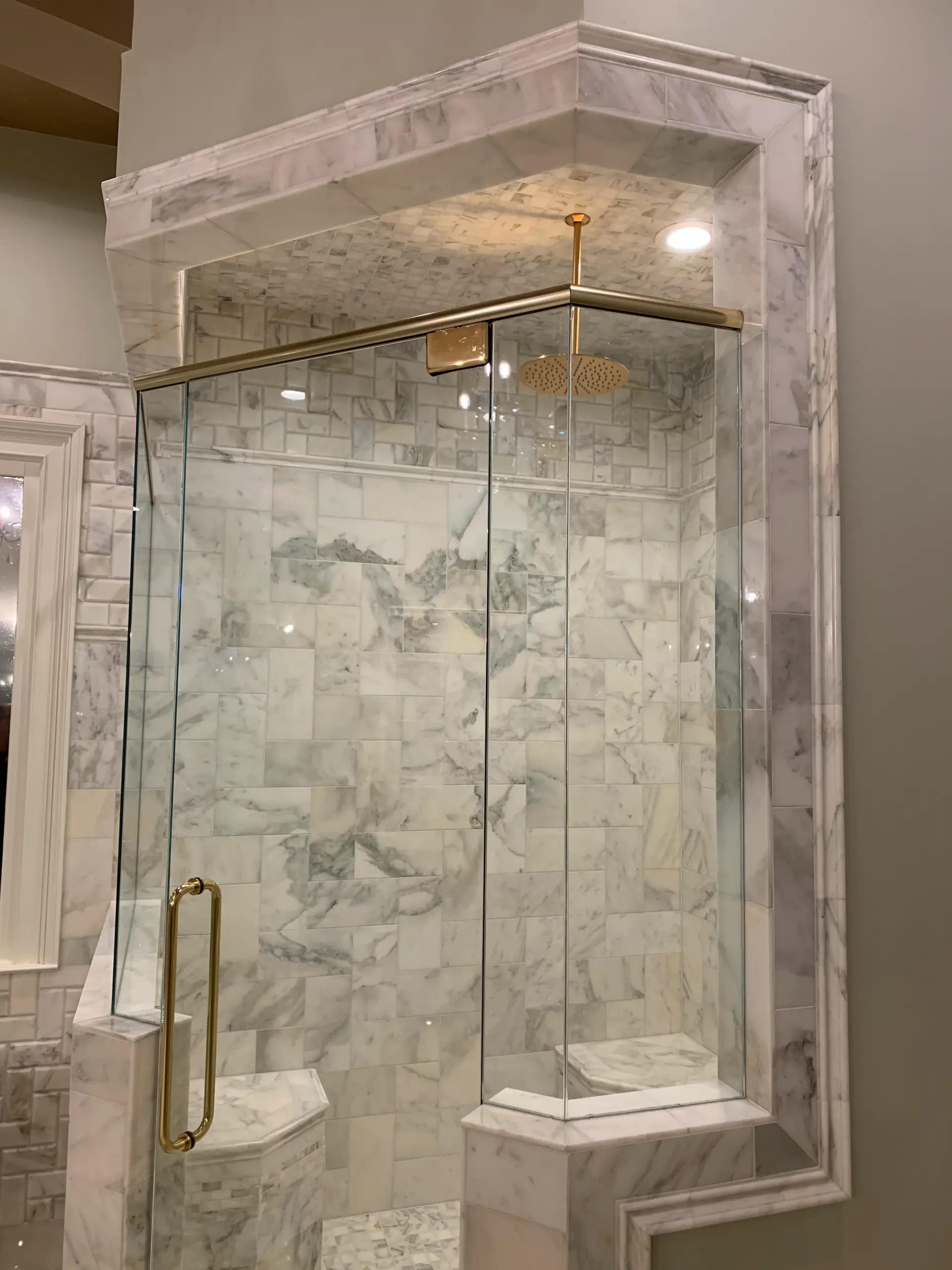
Calacatta marble is the most recognizable of the Italian marbles — a white or off-white ground with bold, dramatic veining in grey and gold that moves through the stone in broad, sweeping strokes rather than the finer, more consistent veining of Carrara. Calacatta Gold and Calacatta Borghini are the most prized varieties, with golden-warm veining that pairs extraordinarily well with gold hardware.
For a shower surround, large-format tiles in 12×24 or 24×48 inch dimensions are the appropriate choice. Larger tiles mean fewer grout lines, which means the veining reads more continuously across the surface. The shower in this project uses 24×48 inch Calacatta tile set vertically on the walls, which emphasizes the height of the enclosure and makes the ceiling feel farther away.
The feature wall — the back wall directly opposite the door — is book-matched: two adjacent tiles oriented so that their veining mirrors across the grout joint like a Rorschach pattern. Book-matching requires selecting tiles from the same production run with compatible veining, aligning them precisely at the centerline, and cutting with extreme accuracy. The result is a wall that looks less like tile and more like a continuous marble slab — which is exactly the point.
The shower floor presents a design tension that does not exist elsewhere in the bathroom: the floor must provide adequate slip resistance while also serving as a design element visible through the frameless glass. Large-format tiles on a shower floor are a code problem — they require larger grout joints to accommodate the required slope to the drain, which look clumsy, and they do not provide sufficient texture underfoot.
Marble basket weave mosaic — typically 1×2 inch or 1×3 inch pieces in an interlocking herringbone-like pattern — solves both problems simultaneously. The small tile size allows the mortar bed to achieve the required 1/4-inch-per-foot slope to the drain without visible lippage. The many small grout joints provide texture and grip that meets or exceeds slip resistance requirements. And the pattern is classically beautiful — associated with the finest bathrooms in American and European architectural history.
The mosaic in this shower uses Calacatta marble pieces in white and soft grey, creating a two-tone basket weave that echoes the veining of the wall tile without exactly matching it. The slight variation keeps the floor from becoming too busy or too static. The grout color is critical — a warm grey that reads as a medium value between the white stone and the grey veins, disappearing visually rather than creating a grid pattern on the floor.
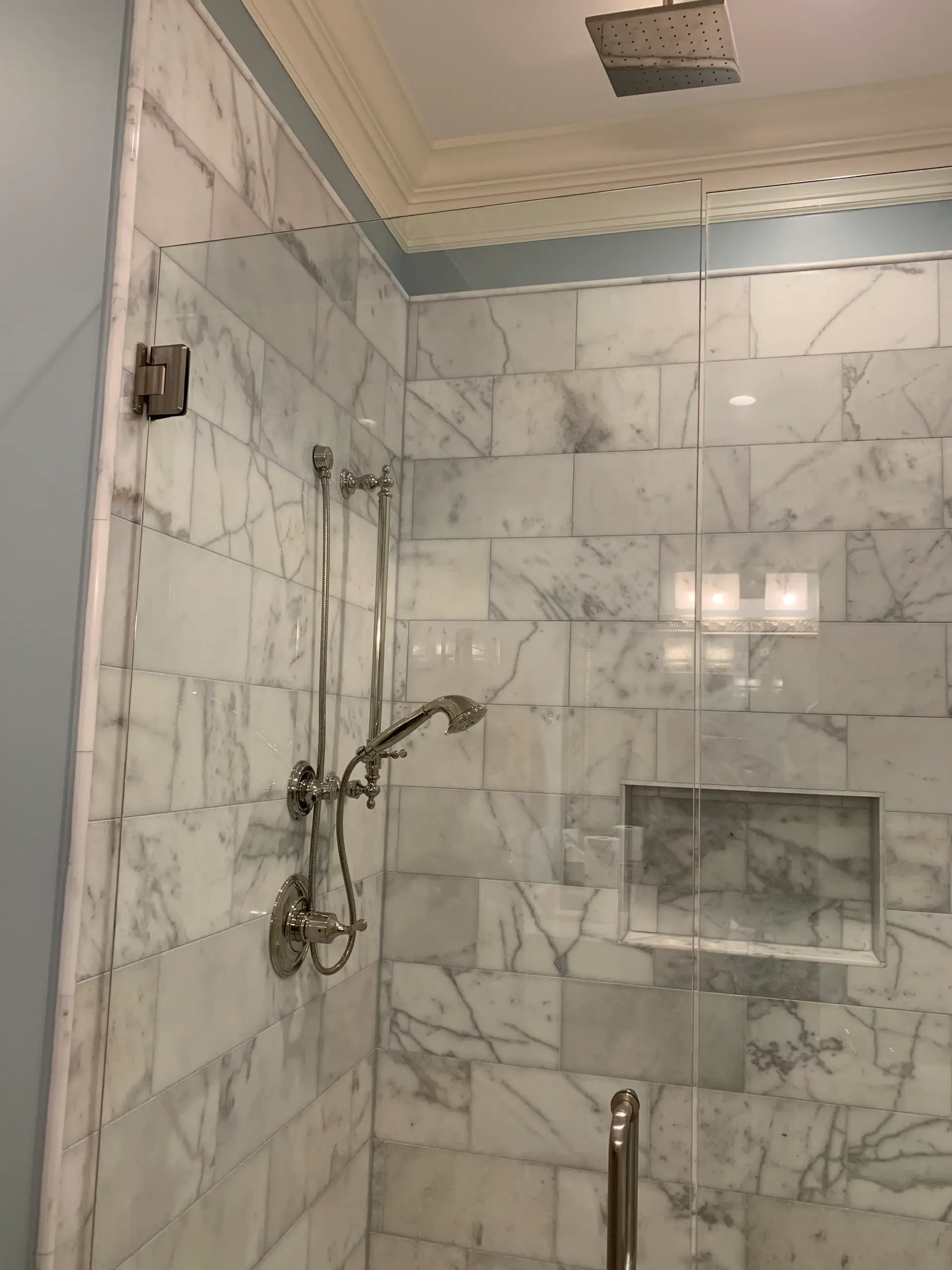
In any bathroom where the tile and the glass are the primary design elements, the hardware finish is the accent color — the element that either warms or cools the entire palette. Gold and brushed nickel represent opposite ends of the warm-cool spectrum, and the choice between them should be made in the context of the overall material palette, not in isolation.
Brushed nickel reads as cool, modern, and understated. It pairs well with grey-toned marble, black fixtures, and contemporary millwork. In a bathroom with a lot of warm tones — gold veining in the marble, warm wood vanity, cream-toned grout — brushed nickel can read as disconnected, a cool note in a warm room that creates visual tension rather than harmony.
Gold PVD hardware — specifically the brushed or satin gold finish rather than the highly polished variety — introduces warmth that resonates with the golden veining in Calacatta marble and creates a cohesive, high-end palette that photographs as beautifully as it reads in person. The key is consistency across every fixture in the room: door handle, hinges, rain head, body jets, thermostatic valve trim, towel bar, and robe hooks. When gold is used on everything, it reads as intentional. When it is mixed casually with other finishes, it reads as incomplete.
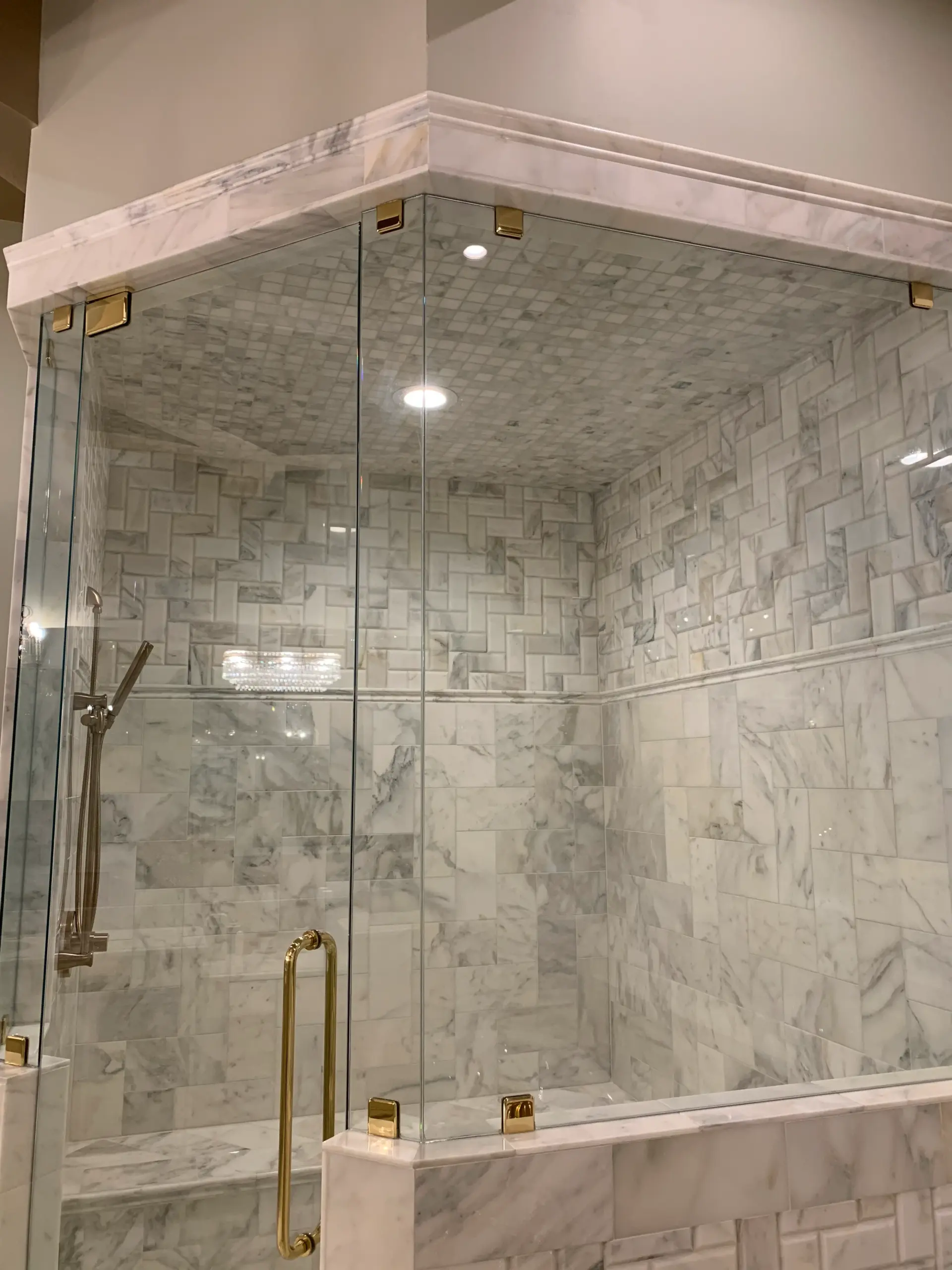
A ceiling-mounted rain head is one of the most requested luxury shower upgrades — and one of the most frequently misspecified. The rain head must be positioned over the center of the standing area, not over the center of the shower floor, which can differ by as much as 24 inches depending on the bench position. Misplaced rain heads produce an off-center shower experience that feels wrong from the first use.
The head diameter also matters. A 12-inch rain head produces a noticeably different experience than an 8-inch model — the larger head fills more of the standing area with water at lower pressure, which is the sensation that actually mimics rainfall. In a shower with 10-foot ceilings, a larger diameter head compensates for the height and maintains the immersive quality that would otherwise be lost with distance.
The built-in bench in this shower is a full-width marble-topped seat on the back wall, tiled continuously with the surrounding walls so that it reads as an extension of the enclosure rather than an added element. The bench height — 17 inches from the floor — matches the standard seat height used throughout interior design, ensuring it is comfortable for both sitting and as a surface for bath products. The bench eliminates the need for a niche in the primary wall, preserving the book-matched marble feature without interruption.
Entry ($8,000–$14,000): Standard corner or walk-in configuration, 3/8-inch frameless glass with chrome or brushed nickel hardware, porcelain tile in marble look, standard overhead and hand shower. A significant upgrade from framed glass at an accessible price point.
Mid-Range ($14,000–$28,000): Frameless glass with gold PVD hardware, natural marble wall and floor tile, basket weave mosaic floor, thermostatic valve, rain head, built-in bench. This tier reflects the typical specification for the type of shower shown in this project.
Luxury ($28,000–$55,000+): Large-format or full-slab marble walls, book-matched feature wall, custom frameless neo-angle or walk-in configuration, body jets, steam generator, recessed rain head, bespoke hardware package, heated floor. Reserved for master bathrooms where the shower is the primary design statement of the entire home.
We work with North Atlanta homeowners who want frameless glass and natural marble installed with the precision the materials demand.
Schedule a ConsultationAtlantic Construction & Remodeling serves luxury homeowners throughout the North Atlanta metropolitan area, including the following counties and communities: