

A master bathroom is no longer just a functional room at the end of a hallway. When every surface is full-slab marble, when a freestanding soaking tub anchors the room like a piece of sculpture, and when gold hardware catches the light from a crystal chandelier overhead — the bathroom becomes the most private, most indulgent sanctuary in the home.
This project represents one of the most complete bathroom transformations Atlantic Construction & Remodeling has executed in North Atlanta. Every decision was made in service of a single ambition: to produce a five-star hotel spa experience in a private residence — one that would outlast trends because it was built on proportion, materiality, and craft rather than novelty.
The brief was clear: marble from floor to ceiling, a freestanding tub as the visual centerpiece, a frameless glass shower large enough to feel generous, gold fixtures throughout, and a ceiling treatment worthy of the room below it. What follows is a detailed account of how each element was selected, installed, and integrated into a cohesive whole.
Before a single tile is selected, the floor plan must support the ambition. A freestanding tub requires clearance on all four sides — a minimum of 24 inches from the nearest wall or fixture, and ideally 30 to 36 inches to allow comfortable movement and to preserve the sculptural quality of the tub itself. Placing a freestanding tub flush against a wall defeats its purpose entirely.
In this renovation, the layout was restructured to position the tub beneath the chandelier, in a dedicated alcove framed by marble walls on three sides and open to the room on the fourth. The shower was positioned adjacent but separated by a low knee wall, creating a visual dialogue between the two bathing elements without making either feel crowded.
The double vanity was moved to allow a longer continuous run of marble countertop and to create a clear sightline from the entry door straight to the freestanding tub — so the first thing you see when you walk in is exactly the statement piece the room was designed around.
“The moment a client walks into a master bathroom and the freestanding tub is the first thing they see — perfectly centered, flanked by marble, lit from above — that is the moment the entire project justifies itself.”
Not all freestanding tubs are created equal. The market ranges from lightweight acrylic shells that flex underfoot to cast iron soaking tubs that retain heat for hours and feel as substantial as a piece of furniture. For a project of this caliber, the choice is almost always cast iron or stone resin — materials that justify the scale of the room and deliver a bathing experience that acrylic simply cannot match.
The tub selected for this project is a double-ended oval soaking tub in a matte white finish, chosen specifically because its clean, unadorned profile would not compete with the complexity of the marble surroundings. When every wall is a visual event, the tub needs to be a quiet anchor — present and commanding, but not decorative in its own right.
Weight is a practical consideration that many homeowners overlook. A cast iron tub filled with water can exceed 800 pounds. Before installation, structural reinforcement of the subfloor was required to distribute that load properly — a step that is non-negotiable and must be planned well before the tub arrives on site.
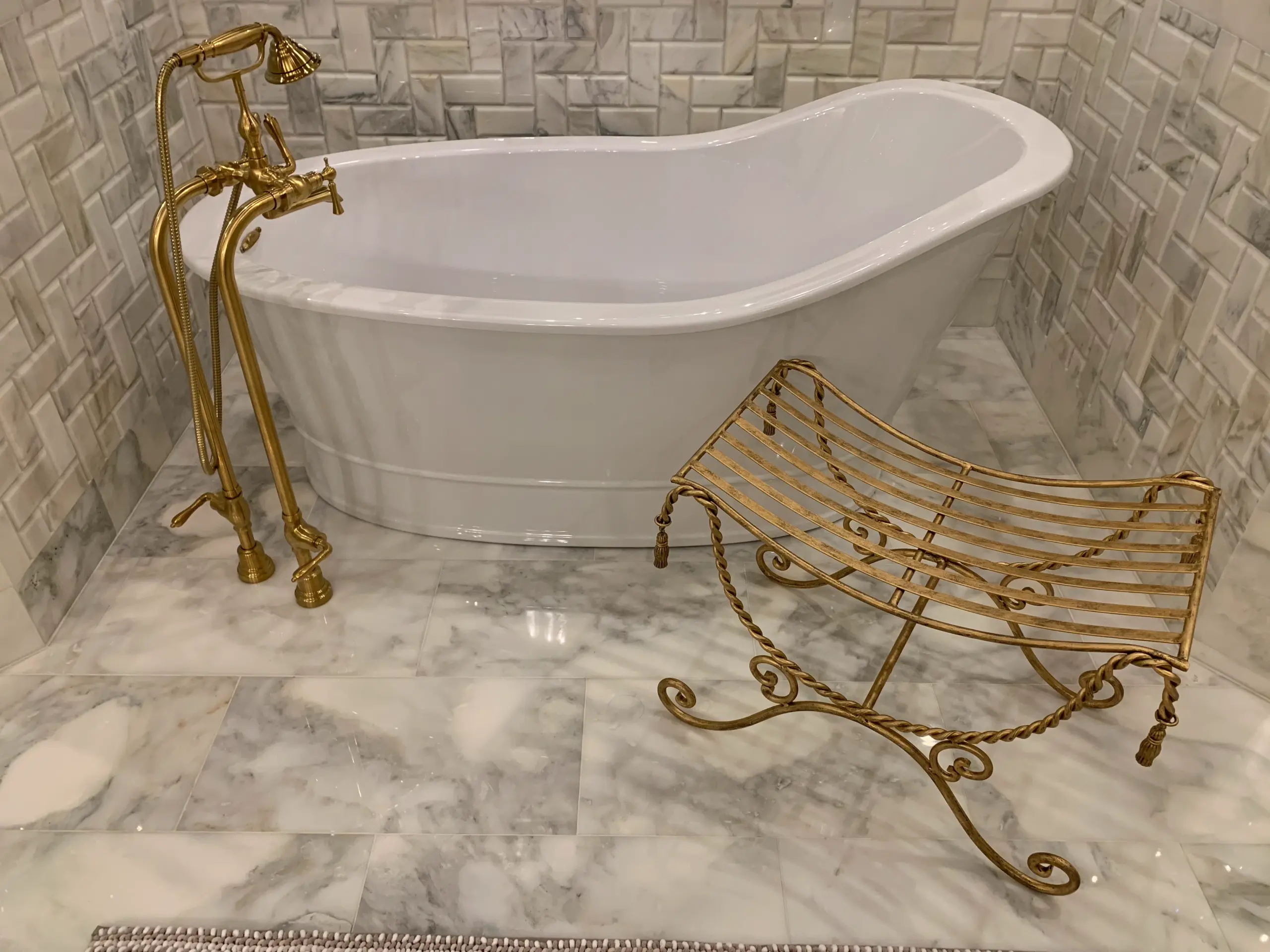
When a freestanding tub sits in open space, the faucet cannot hide behind the deck or disappear into a wall. It must stand on its own — and a floor-mount tub filler in brushed gold does exactly that. Rising from the marble floor on a slender articulated stem, the floor-mount filler is arguably the most photographed fixture in any luxury bathroom, and for good reason.
The fixture selected here features a curved gooseneck spout with integrated hand shower, a combination that preserves the minimalist elegance of the silhouette while adding practical flexibility. The brushed gold PVD finish — applied through physical vapor deposition rather than paint or lacquer — will not tarnish, chip, or require the ongoing maintenance of unlacquered brass.
Placement matters as much as the fixture itself. The floor-mount filler is positioned at the foot of the tub rather than the side, so that when viewed from the entry, the tub and faucet read as a single composition — the long oval of the tub in white, the vertical gold line of the filler beside it, both set against the unbroken marble field behind.
In a true spa suite, the tub and shower are not competing features — they are complementary experiences that serve different moods and different moments. The shower is functional, efficient, invigorating. The tub is ceremonial, slow, restorative. They should be visible to each other but spatially distinct, separated enough that each retains its own sense of place.
The frameless glass shower in this bathroom uses the same Calacatta marble tile as the tub surround, creating material continuity across the two spaces. The glass itself — 3/8-inch tempered, with no visible frame — essentially disappears, allowing the marble to read as a continuous envelope. The gold hardware on the shower door echoes the tub filler, tying the two zones together without visual interruption.
The shower is sized generously: a five-foot by four-foot footprint with a linear drain, a rain head recessed into the ceiling, and a built-in bench on the back wall. The bench serves double duty — practical seating and a natural shelf for bath products that doesn’t require a niche to interrupt the marble continuity.
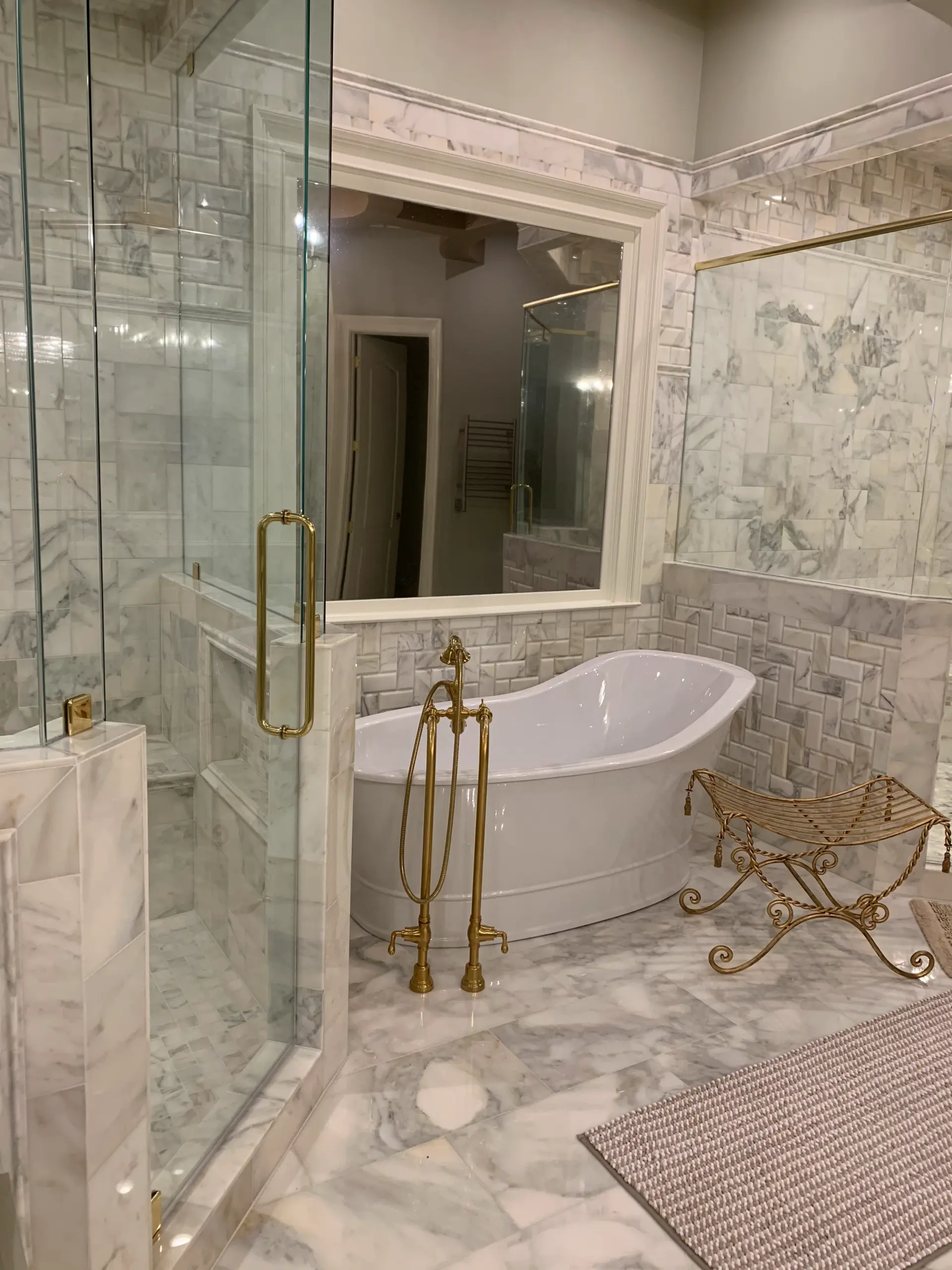
Marble selection for a full-surround installation requires more decisions than most clients anticipate. Large-format slabs — 24×48 or 32×64 inch tiles — are the standard for feature walls and shower enclosures in luxury bathrooms because they minimize grout lines and allow the natural veining of the stone to read as a continuous, painterly composition.
The floor, however, is where basket weave mosaic becomes the appropriate choice. A 1×2 inch marble basket weave in white and dove grey provides the slip resistance required by code for wet areas, while adding a layer of visual texture that makes the floor feel purposeful rather than merely functional. The small scale of the pattern also makes the large tiles on the walls feel even more monumental by contrast.
Book-matching the wall tiles — orienting adjacent slabs so that the veining mirrors across the grout joint like an open book — is the finishing detail that separates a luxury installation from a standard one. Book-matched marble creates a symmetry that reads as intentional, almost architectural, transforming what would otherwise be random stone movement into a deliberate visual pattern.
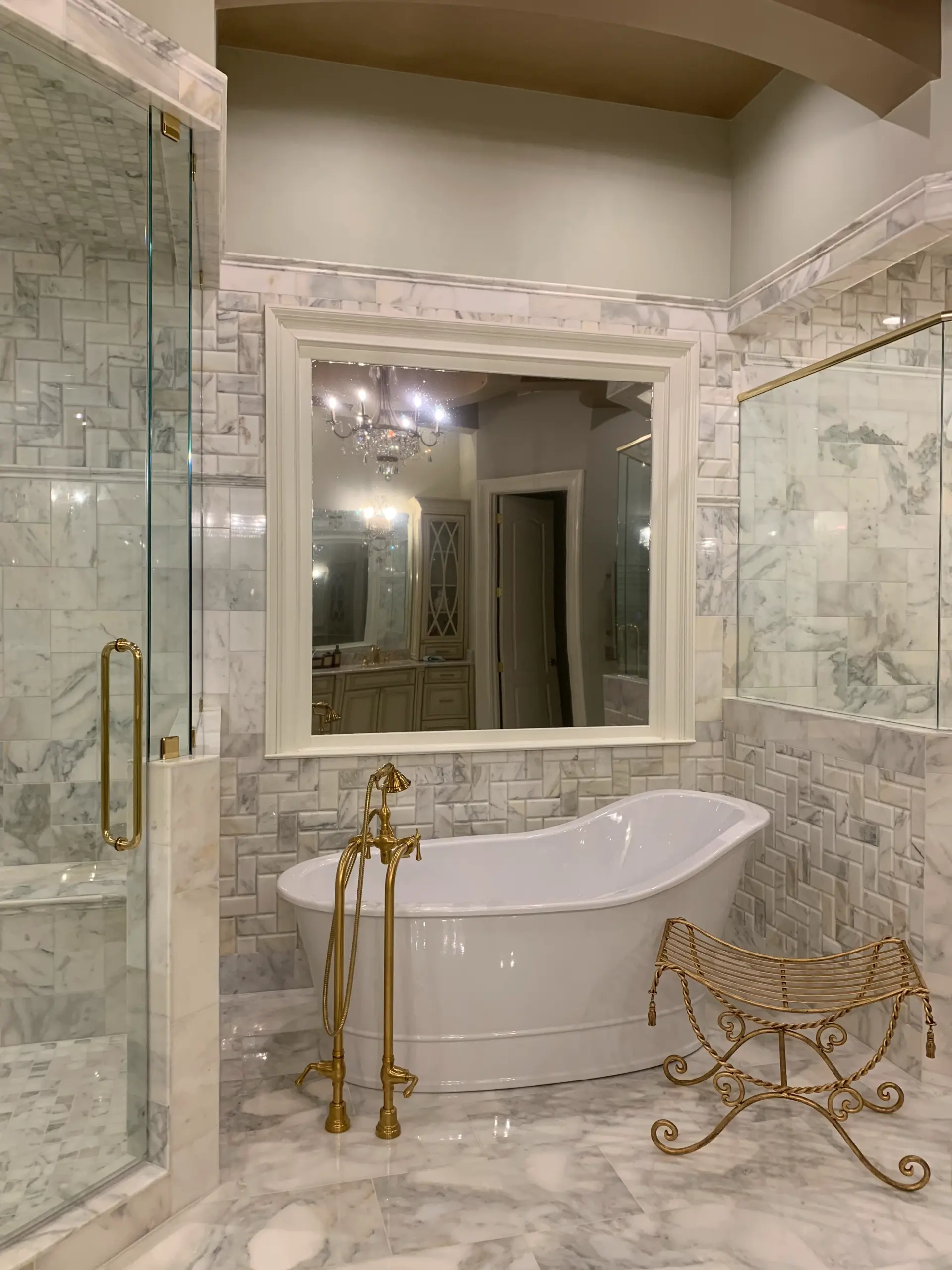
Few decisions in a luxury bathroom renovation are more debated than whether a chandelier belongs in a wet environment. The answer, executed properly, is an unqualified yes — and the difference it makes to the emotional register of the room is difficult to overstate. A crystal chandelier over a freestanding tub transforms bathing from a routine into a ritual.
The practical requirements are non-negotiable: the fixture must carry an appropriate UL damp or wet location rating, must be installed by a licensed electrician using a weatherproof junction box, and must be positioned a minimum of eight feet from the tub rim horizontally or at a height that places it outside Zone 1 as defined by the National Electrical Code. In a room with high ceilings, this is typically achievable without compromise.
The chandelier installed above the tub in this project is a multi-tier crystal fixture with brass-toned canopy arms, sized to fill the ceiling alcove without overwhelming the space below. By day, it reads as jewelry — light refracting through the crystal droplets and scattering across the marble walls. At night, dimmed to 20 or 30 percent, it produces the exact quality of warm, diffused light that makes a marble bathroom feel like a suite at the Ritz.
Entry-Level Luxury ($45,000–$65,000): Porcelain tile in marble-look finish, freestanding acrylic tub, semi-frameless shower enclosure, brushed gold fixtures, standard chandelier. Delivers the visual language of a spa suite at a more accessible price point.
Mid-Range Luxury ($65,000–$110,000): Natural marble tile walls and floor, cast iron or stone resin freestanding tub, full frameless glass shower, floor-mount gold tub filler, book-matched feature wall, crystal chandelier. This is the tier represented in this project.
Ultra-Luxury ($110,000–$200,000+): Full-slab marble walls (book-matched slabs, not tile), custom millwork vanity, heated marble floors, steam shower, custom chandelier, sculptured ceiling treatment, bespoke hardware. Reserved for master bathrooms where no design compromise is acceptable.
It is not any single element — not the marble, not the chandelier, not the gold fixtures — that produces the hotel-suite feeling. It is the accumulation of decisions made at every scale, from the proportions of the room to the radius of the tub’s rim to the temperature of the lighting. Every detail must be resolved with the same care as the largest, most visible choices.
Hotel spa suites feel the way they feel because nothing was left to chance or convenience. The towel hooks are at the right height. The mirror is lit from the sides, not overhead, so it flatters rather than flattens. The floor is warm underfoot because radiant heat was installed beneath the marble. The ventilation is silent. The door closes with a solid, quiet click.
In a residential renovation, replicating that experience means treating the bathroom as seriously as any other room in the home — not as an afterthought or a utilitarian space to be finished quickly, but as an environment that deserves the same architectural attention as the living room or kitchen. Atlantic Construction & Remodeling approaches every luxury bathroom with exactly that standard.
We serve homeowners throughout North Atlanta who are ready to invest in a master bathroom that belongs in a five-star hotel.
Schedule a ConsultationAtlantic Construction & Remodeling serves luxury homeowners throughout the North Atlanta metropolitan area, including the following counties and communities: