

A luxury kitchen is never simply a collection of expensive appliances. It is an environment — one designed with the same architectural intelligence and material discipline as the finest rooms in the home. Custom glazed cabinetry, a hand-crafted range hood, Calacatta marble countertops, and a pot filler positioned above the range are not luxury upgrades layered onto a builder kitchen. They are the constituents of a completely reimagined culinary space designed from the floor up.
The kitchen photographed here — sage-toned glazed cabinetry, an ornate custom hood, a lattice-pattern backsplash tile, and a coffered ceiling that carries the home’s architectural language directly into the heart of the house — represents the standard Atlantic Construction brings to every luxury kitchen project in the north Atlanta metro. Every decision, from the cabinet door profile to the faucet finish, is made as part of a unified design conversation.
Glazing is a decorative painting technique applied over a base coat to add depth, dimension, and the appearance of age and patina to painted cabinetry. The glaze — a translucent medium tinted with pigment — is applied over the cured base coat and then partially wiped or distressed, leaving heavier concentrations of color in the recesses of the door profiles and lighter coverage on the raised panel faces. The result is a surface that reads as layered and dimensional rather than flat, with a quality that references European painted furniture traditions.
The distinction between glazed cabinetry and standard painted cabinetry is immediately apparent in person. A flat-painted cabinet door looks uniform and machine-made — because it is. A properly glazed door looks as though it has been through multiple layers of paint and time, with the subtle depth that craftsman-applied finish creates. In a kitchen with sage, gray-green, or cream tones, glazing adds the warmth and complexity that prevents the space from reading as cold or showroom-flat.
“A glazed cabinet finish is not about making cabinets look old. It is about making them look considered — like they were painted by a hand that understood the relationship between light, depth, and the profiles it was working with.”
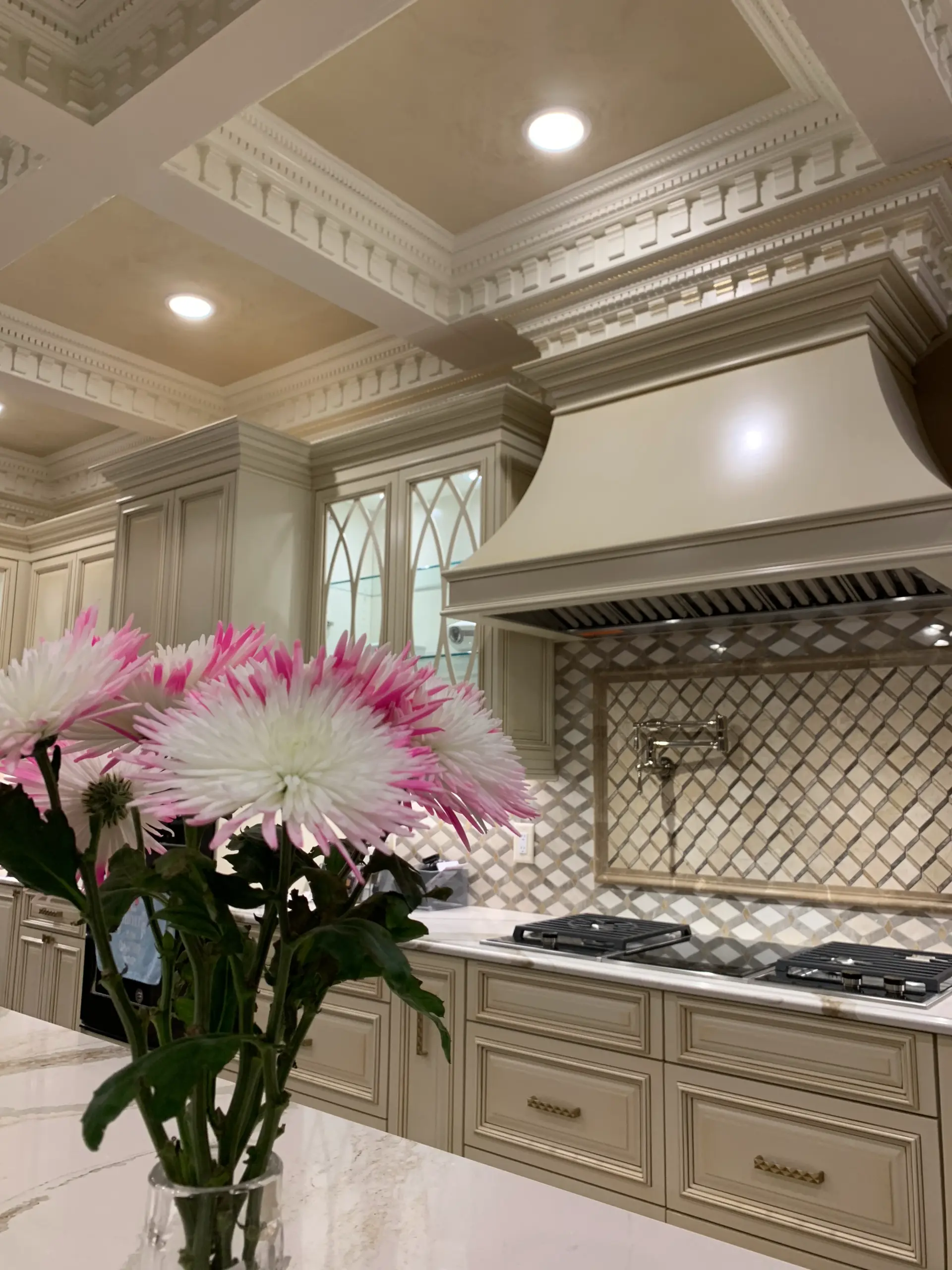
The glaze concentrates in the recesses of the raised panel door profile, creating shadow and depth that flat paint cannot replicate.
In a luxury kitchen, the range hood is simultaneously the most prominent architectural feature and a critical piece of functional equipment. It must capture steam, smoke, and cooking odors effectively — which requires adequate CFM capacity, proper capture area, and the right placement relative to the range below. It must also be visually scaled to anchor the kitchen composition, projecting with enough presence to terminate the vertical axis that runs from the countertop through the backsplash and upward to the ceiling.
The ornate range hood design shown here — with carved appliqués, dentil molding at the cornice, curved corbels at the lower sides, and a painted finish that matches the surrounding cabinetry — treats the hood as a piece of furniture-scale architecture rather than an appliance housing. The hood’s proportions are calibrated to the width of the range below and the height of the ceiling above, creating a visual column of importance that draws the eye immediately upon entering the kitchen. Atlantic Construction designs custom hoods in-house for every luxury kitchen project.
A pot filler is a wall-mounted articulating faucet positioned above the range, designed to allow a cook to fill large pots directly on the burner without carrying them full of water from the sink. In practical terms, it is a genuine quality-of-life improvement for anyone who regularly cooks large batches of pasta, stocks, or braises. In design terms, it is one of the most photographed details in any luxury kitchen because it signals — clearly and elegantly — that the kitchen was designed by someone who cooks and understands cooking.
Pot filler selection should align with the kitchen’s overall hardware finish. In a kitchen with gold or brass hardware, a brushed gold pot filler continues the metallic language of the space. In a kitchen with matte black hardware, a matte black pot filler creates a graphic punctuation above the range. The filler’s arm length and reach should be verified against the range width and burner positions to ensure all burners — including the back burners — are accessible.
Calacatta marble is among the most desirable natural stones in luxury kitchen design. Quarried in the Apuan Alps of Italy, Calacatta is distinguished from Carrara marble by its whiter background and bolder, more dramatic veining — typically bold gray, gold, or warm brown veins on a near-white field. It is the stone that most people picture when they envision a luxury kitchen countertop, and for good reason: in a well-lit kitchen, the contrast between the white ground and the bold veining creates a visual richness that quartzite, porcelain, and engineered stone reliably fail to replicate.
The honest counterpart to this enthusiasm is that Calacatta marble is etching-sensitive and requires thoughtful maintenance. Acidic liquids — lemon juice, vinegar, wine — will etch the polished surface if left in contact, creating dull spots that require professional re-polishing. Many luxury kitchen designers address this by specifying honed or leathered marble finishes for kitchen countertops — these textures accept etching more gracefully, as the matte surface already has a non-reflective quality that makes etch marks far less visible.
Quartzite is the practical alternative that most closely approximates Calacatta’s aesthetic. Super White and White Macaubas quartzites have comparable white-ground, bold-vein appearances and are significantly harder and less etch-prone. For clients who entertain frequently and do not want to manage marble, quartzite is the recommended alternative without meaningful aesthetic compromise.
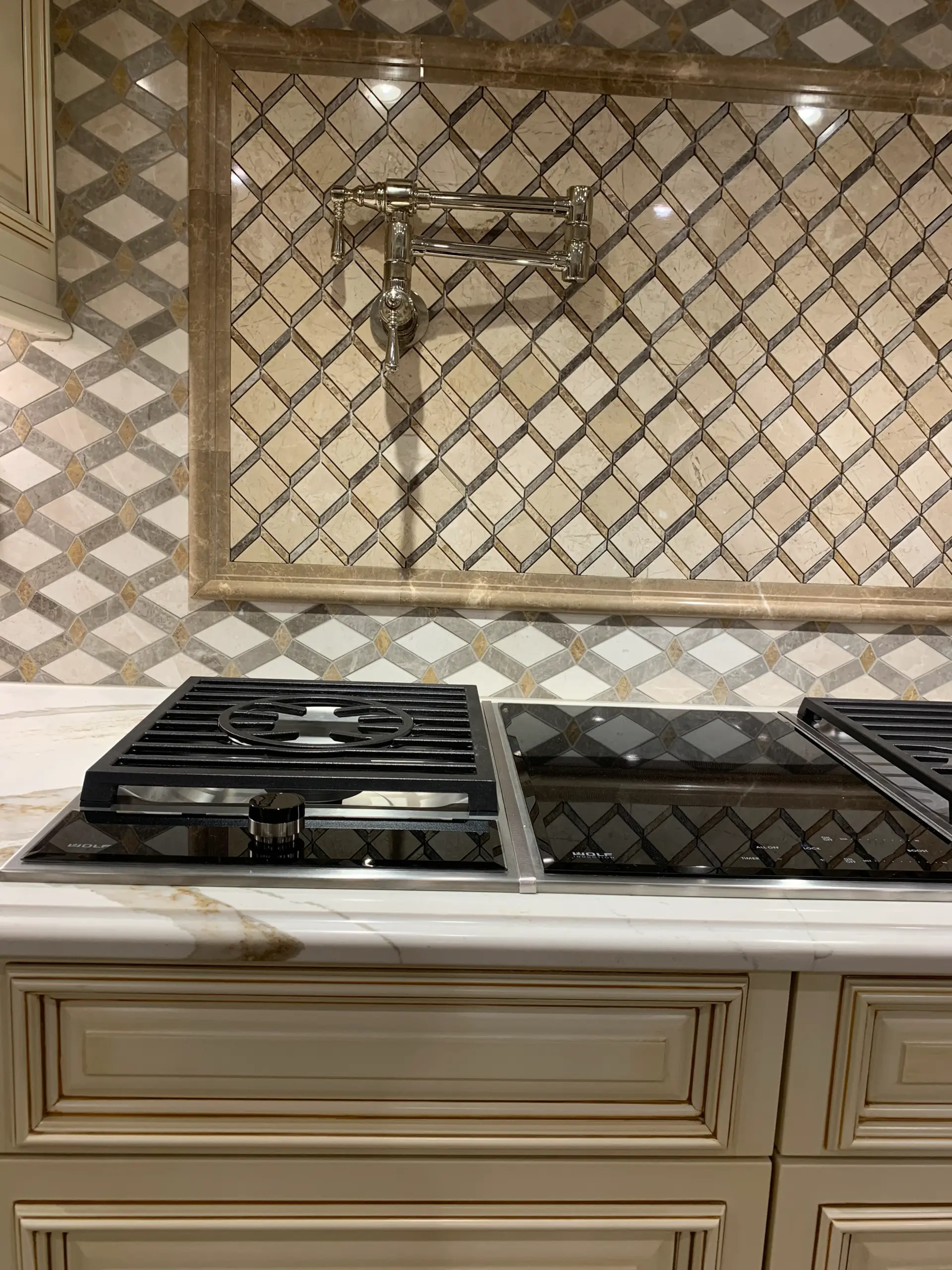
Calacatta marble countertops and a hand-set lattice tile backsplash establish the material language of the kitchen at the cook’s eye level.
The backsplash between the countertop and the underside of the upper cabinets — or the full backsplash to the ceiling in the hood surround area — is one of the most visible surfaces in the kitchen. A lattice pattern tile in a cream or off-white body reads as simultaneously pattern-rich and restrained, adding visual texture and geometric interest without competing with the marble countertop or the glazed cabinet finish. The geometric regularity of the lattice also provides a neutral foil to the organic veining of the marble, creating a visual balance between the two dominant surface materials.
The hand-set nature of lattice tile — each piece individually positioned and grouted — is itself a marker of custom craftsmanship. A skilled tile setter working with a lattice pattern at the full height of the hood surround is producing work that takes genuine skill and care to execute. The grout joint width, the alignment of the geometric centers, and the transition to the marble countertop edge are all details that distinguish a professionally installed kitchen from a DIY one.
Perhaps the most unexpected luxury detail in the kitchen photographed here is the coffered ceiling. Coffered ceilings are most commonly associated with formal living rooms, dining rooms, and studies — spaces where traditional architectural vocabulary is expected. Bringing a coffered ceiling with molding profiles into the kitchen signals that the architect and designer treat the kitchen as a room worthy of the same architectural investment as the formal spaces of the home. It is a design decision that reads as committed and coherent — proof that the design language of the home extends everywhere, not just where guests are expected to linger.
A fully custom luxury kitchen in a north Atlanta home — with glazed cabinetry, custom range hood, Calacatta marble or premium quartzite countertops, professional appliances, and premium tile backsplash — typically ranges from $120,000 to $280,000+ depending on kitchen footprint, appliance specification, countertop material and slab count, and the complexity of ceiling and millwork details. Kitchens in the $120K–$160K range represent standard luxury finishes with semi-custom cabinetry; kitchens in the $200K–$280K+ range incorporate fully custom cabinetry, professional-grade appliance suites, coffered ceilings, and specialty stone throughout. Atlantic Construction manages all cabinetry, millwork, stone, tile, and appliance coordination under a single contract.
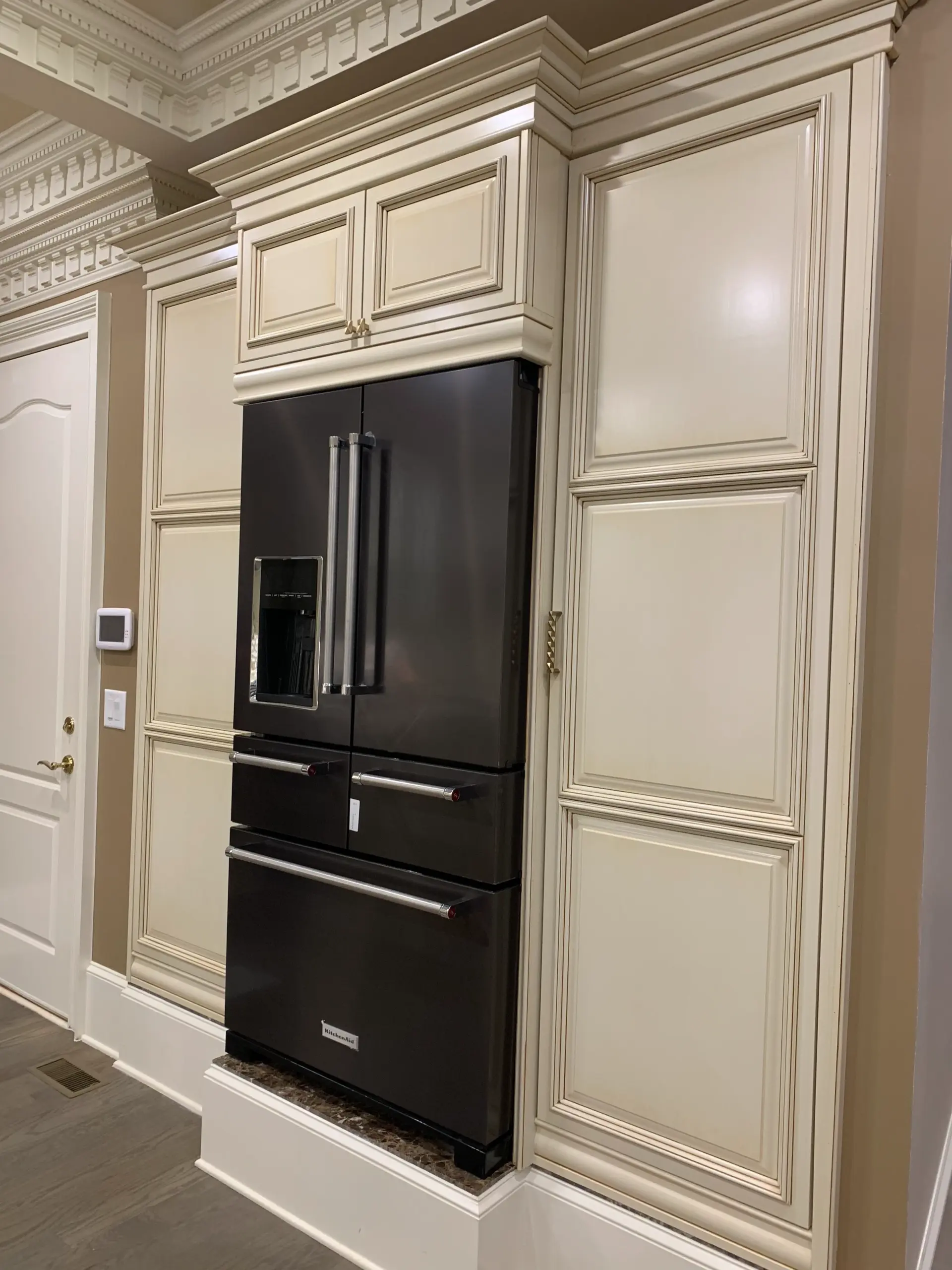
The full kitchen composition — coffered ceiling, glazed cabinetry, custom hood, and marble island — demonstrates what it means to design a kitchen as a complete architectural environment.
Atlantic Construction & Remodeling designs and builds fully custom luxury kitchens — glazed cabinetry, hand-crafted range hoods, natural stone, and architectural ceiling design — for clients throughout north Atlanta.
Request a ConsultationAtlantic Construction & Remodeling — luxury custom home design and build serving the north Atlanta metro within a 30-mile radius of Duluth, GA.