

Most bathroom renovations end at the tile line. The floor is addressed, the walls are addressed, the fixtures are replaced — and then the ceiling is painted white and forgotten. In a luxury master bathroom, this is the single largest missed opportunity. The ceiling is the largest uninterrupted surface in the room, and in a bathroom with high ceilings, it is also the most visible. A custom groin vault with a crystal chandelier at its crown transforms the experience of the room at a level that no tile upgrade can match.
The sculpted ceiling in this master bathroom is one of the most ambitious residential ceiling treatments Atlantic Construction & Remodeling has executed. A full groin vault — four curved surfaces intersecting at a central crown — was built in plaster over a custom steel and wood substrate, finished in a warm dove white with subtle shadow detailing at the ribs. The crystal chandelier at the center draws the eye upward the moment you enter the room, reorienting the geometry of the space and making every other element in the bathroom feel more deliberate.
Understanding what a groin vault is, how it is built, why the chandelier is not a frivolity but a structural part of the ceiling composition, and how this type of ceiling changes the emotional experience of a room — these are the questions this post is designed to answer for homeowners who want a bathroom that is, architecturally, as serious as the rest of their home.
A groin vault is formed by the intersection of two barrel vaults at right angles. Where the two barrels meet, they create a groin — a curved diagonal rib running from the corner of the room to the crown of the ceiling. A rectangular room with a groin vault ceiling has four curved surfaces meeting at four diagonal groin ribs, producing a ceiling that rises from relatively flat edges to a domed crown at the center.
The groin vault has been used in architecture for over two thousand years — in Roman bath houses, Gothic cathedrals, and Renaissance palaces — precisely because it solves a problem that flat ceilings cannot: how to make a room feel expansive and grand without increasing the actual volume of the space. The upward curve of the vault draws the eye toward the center of the room, and the shadow play along the curved surfaces changes throughout the day as the light angle shifts, making the ceiling feel alive in a way that a flat surface never can.
In a bathroom, the groin vault serves an additional functional purpose: the curved form eliminates the flat ceiling plane where condensation most commonly collects. The slope of the vault directs moisture toward the walls where it can be ventilated away from the room, reducing the risk of mold and finish damage over time. This is why Roman bath houses were vaulted — not only for grandeur, but because a vaulted ceiling in a wet environment outlasts a flat one.
“A vaulted ceiling is not a luxury — it is an argument. It argues that this room matters enough to be treated as architecture, not just construction. The chandelier is the exclamation point at the end of that argument.”
A residential groin vault begins with structural engineering and a custom substrate. The ceiling framing must be designed to support the weight of the plaster and the curved form, which typically requires additional blocking, curved metal furring channels, and — for larger vaults — a steel armature that establishes the precise geometry of the curves before any plaster is applied.
The substrate is covered in a base layer of metal lath — a diamond-mesh metal sheet that provides mechanical bonding for the plaster. Scratch coat is applied over the lath and combed to create a key for the brown coat. The brown coat builds the form to within a few millimeters of the final surface. Each coat must cure fully before the next is applied — a process that takes days per coat and cannot be accelerated without compromising the finished surface.
The finish coat is applied by a master plasterer using traditional lime putty or gypsum finish plaster, worked with steel trowels to a surface of extreme uniformity. The groin ribs are formed by hand, with a template — a shaped piece of metal or wood called a “rod” — run along the curve to establish the profile. The quality of the final surface depends entirely on the skill of the plasterer, and in this project, the work was executed by a crew with over 25 years of decorative plaster experience.
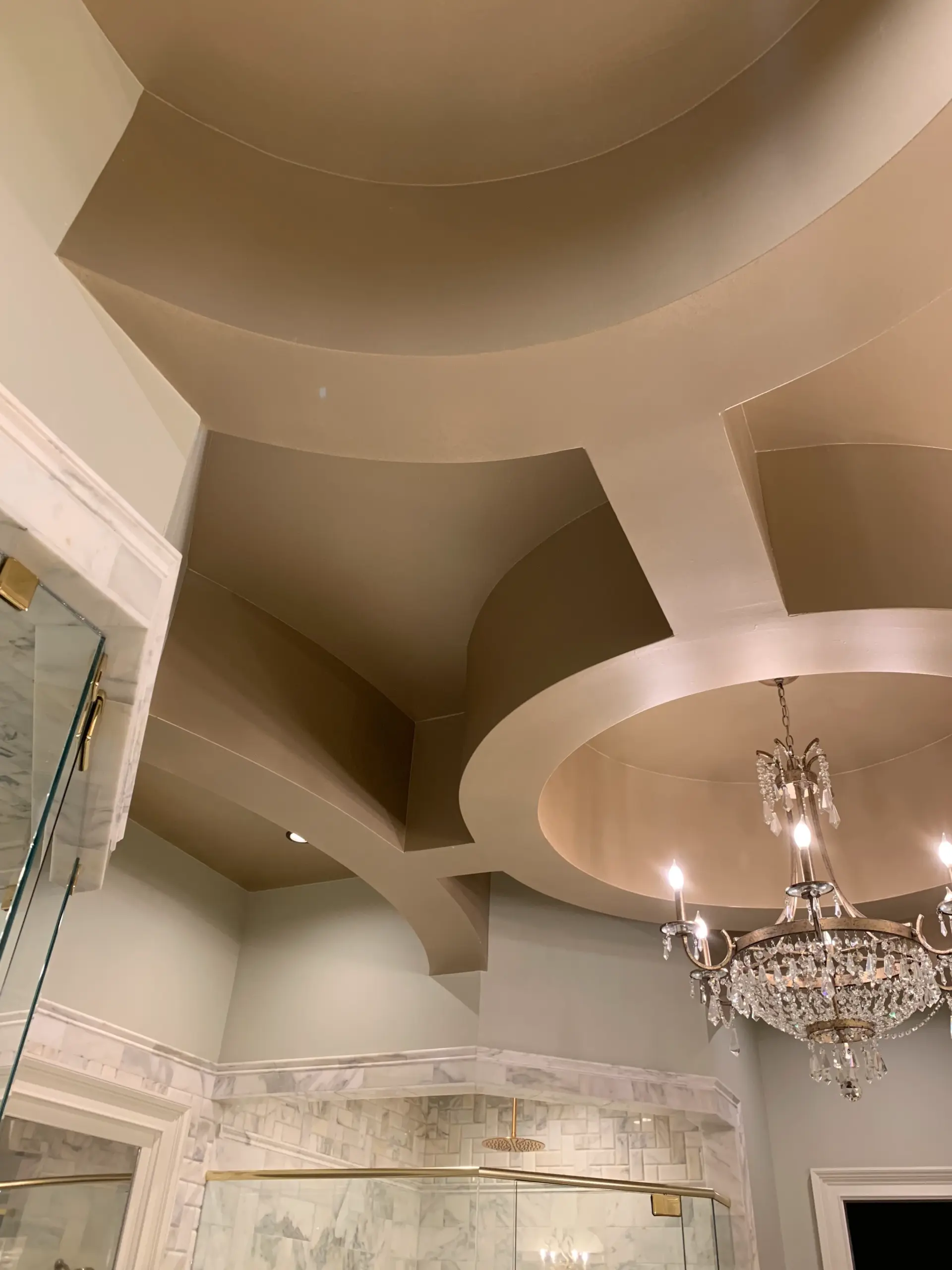
Installing a chandelier in a bathroom is not controversial — it is common in luxury residential projects. What is non-negotiable is the correct electrical specification and installation method. The National Electrical Code (NEC) divides bathrooms into three zones based on proximity to water sources, each with different electrical requirements for fixtures and wiring.
Zone 0 is the interior of the bathtub or shower basin — only IP67 or IP68 rated fixtures may be used here. Zone 1 extends to 8 feet above the tub rim within a 3-foot horizontal radius — fixtures must be IPX4 rated at minimum. Zone 2, which extends beyond Zone 1 to a 2.4-meter radius from the tub, allows standard damp-location rated fixtures. A chandelier positioned directly above the center of a bathroom — over the tub, but at a height of 9 or more feet above the floor — falls in Zone 1 or the boundary of Zone 1 and Zone 2, requiring a UL damp or wet location listing.
The chandelier in this bathroom is a multi-tier crystal fixture with an IP44 (damp location) listing, installed with a weatherproof junction box, a properly rated canopy, and a sealed chain length. All wiring is in weatherproof conduit within the ceiling cavity. The installation was inspected and approved by the local building department before close-in. A chandelier that is correctly specified and correctly installed is as safe as any other bathroom fixture — and dramatically more beautiful.
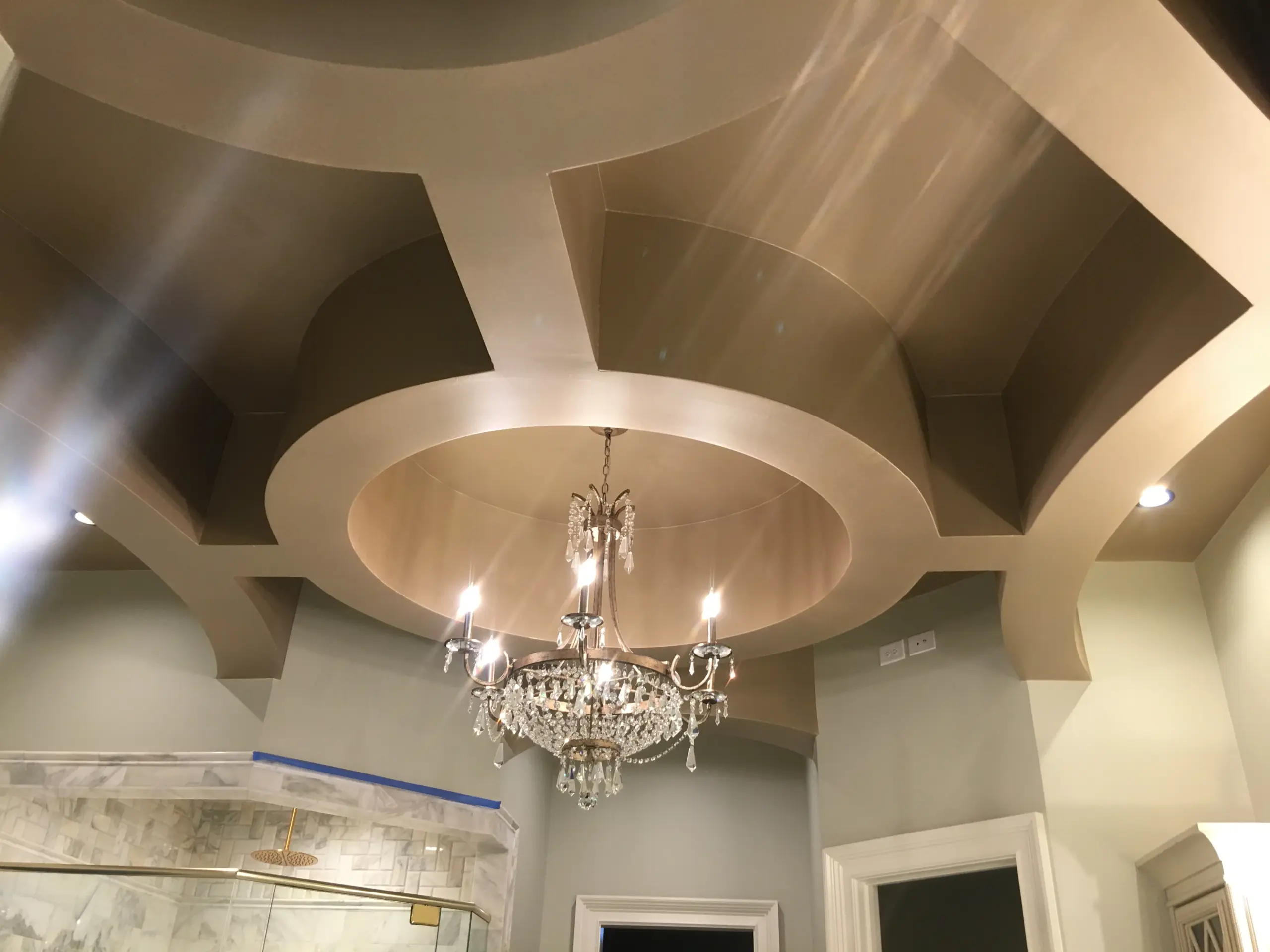
A groin vault ceiling above a marble bathroom creates a vertical dialogue between two of the most prestigious architectural materials in the history of building. The ceiling is soft, curved, and light — white plaster that glows. The floor and walls are hard, veined, and cool — marble that reads as geological permanence. The contrast between the two materials makes each more powerful than it would be alone.
The proportional relationship between the ceiling height and the room footprint is critical. A groin vault that is too flat reads as a failed attempt at a more ambitious form. A vault that rises too steeply makes the room feel like a cave. The ideal rise-to-span ratio for a residential bathroom vault is approximately 1:4 to 1:3 — a room with a 12-foot span should have a vault that rises 3 to 4 feet above the springing line at the walls. This produces the sweeping curve that photographs dramatically and reads beautifully in person.
The chandelier at the crown completes the vertical axis of the room. From any position in the bathroom, the eye can travel from the basket weave mosaic on the floor, up the large-format marble walls, to the curved plaster of the vault, to the crystal chandelier at the apex. This vertical journey is what makes the room feel like a suite rather than a bathroom — the ceiling is not a boundary but a destination.
Homeowners considering a ceiling treatment in a master bathroom typically have three practical options: tray ceiling, groin vault, or coffered ceiling. Each has different requirements, different visual effects, and different price points.
A tray ceiling steps the ceiling up at the center of the room, creating a recessed perimeter and a raised central field. It is the most common luxury ceiling treatment in residential master bedrooms and bathrooms because it is relatively straightforward to build with drywall framing and delivers a meaningful upgrade over a flat ceiling. Tray ceilings accept cove lighting at the perimeter step and a central pendant or chandelier at the crown. The limitation is their familiarity — a tray ceiling in a $2 million home reads as a builder upgrade, not a bespoke architectural gesture.
A coffered ceiling uses a grid of structural or decorative beams to divide the ceiling into recessed panels. Coffered ceilings work best in rectangular rooms where the grid can align with the architecture below — aligned over a freestanding tub, centered on the vanity wall. In a bathroom with complex plumbing and mechanical above the ceiling, the beam grid can be difficult to execute without conflicts. Coffered ceilings are handsome and appropriate but rectilinear — they do not have the organic quality that makes a vault feel alive.
The groin vault is the most demanding and most rewarding of the three options. It requires a skilled plasterer, structural coordination, and more time than either of the other options. But it delivers an effect that is genuinely singular — a ceiling that cannot be purchased at a big-box store or replicated by a general contractor without specialized trade knowledge. In a bathroom designed to compete with the finest hotel suites, a groin vault ceiling is the correct aspiration.
Tray Ceiling with Cove Lighting ($4,500–$9,000): Drywall tray framing, LED cove lighting at the perimeter step, smooth finish coat, painted. A significant improvement over a flat ceiling at a reasonable price. Appropriate for most luxury bathroom renovations.
Coffered Ceiling ($12,000–$22,000): Structural or decorative beam grid in MDF or plaster, recessed panels painted or finished in a contrasting color, central chandelier. Best suited for rectangular rooms where the grid can align with the room geometry below.
Full Plaster Groin Vault ($22,000–$55,000): Custom steel and wood substrate, multi-coat plaster application, hand-formed groin ribs, finish plaster to a fine surface, chandelier integration with proper electrical specification. This is the ceiling treatment shown in this project. Timeline: 6 to 10 weeks for ceiling work alone, concurrent with tile and fixture installation.
We build sculpted plaster ceilings for North Atlanta homeowners who understand that architecture begins at the fifth wall.
Schedule a ConsultationAtlantic Construction & Remodeling serves luxury homeowners throughout the North Atlanta metropolitan area, including the following counties and communities: