

An open-concept floor plan is not simply a matter of removing walls — it is a spatial choreography that requires every volume, every ceiling height, and every sightline to be planned in relation to everything else. This St. Marlo home achieves that: a two-story entry that opens to upper mezzanine views, principal rooms that flow into each other without feeling undefined, and a vertical transparency that makes the whole home feel larger than its square footage.
The most common mistake in open-concept design is treating it as an absence of walls rather than a positive spatial strategy. When walls are simply removed without a coherent plan for how the resulting volume should feel and function, the space reads as unresolved — vast but not grand, open but not comfortable. A well-designed open-concept home uses the open volume to create deliberate spatial relationships between areas, not to create one large undifferentiated space.
In this St. Marlo home, the open concept works because the volumes are differentiated. The entry foyer is a tall, dramatic space with a specific identity. The kitchen and living areas are lower — more intimate, more domestic — but connected to the foyer by sightlines that maintain the sense of the home as a single composition. The upper mezzanine overlooks the entry without being exposed to the living areas below, giving the second floor a sense of privacy within an open architecture.
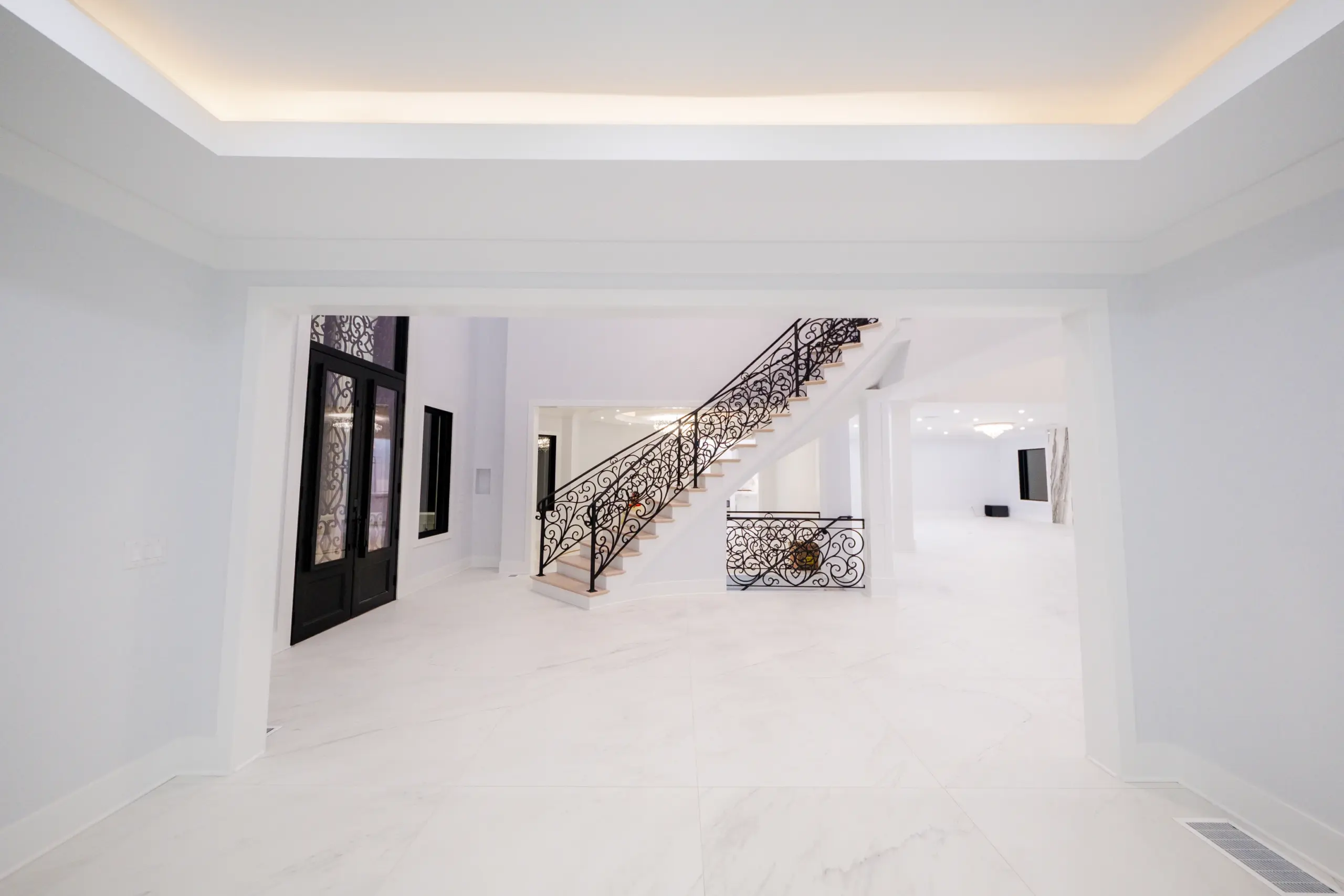
Good open-concept design is as much about what you do not see as what you do. From the entry, you see the foyer chandelier, the upper mezzanine railing, and a glimpse of the kitchen beyond — but you do not see the back hallway or the laundry room. The sightlines were planned during design development to frame desirable views and conceal utilitarian ones, which is impossible to achieve after the floor plan is set.
From the kitchen, the sightline to the entry foyer makes the kitchen feel connected to the grandeur of the home rather than isolated in a service area. From the living room, the view of the upper level through the mezzanine railing adds visual depth and reinforces the home’s vertical dimension. Every position in the principal rooms of this home offers a view that is richer than the immediate space alone would suggest.
“In a well-designed open-concept home, every room benefits from the spaces around it. The kitchen borrows grandeur from the foyer. The living room borrows height from the entry volume. The mezzanine borrows intimacy from being set back from the main floor.”
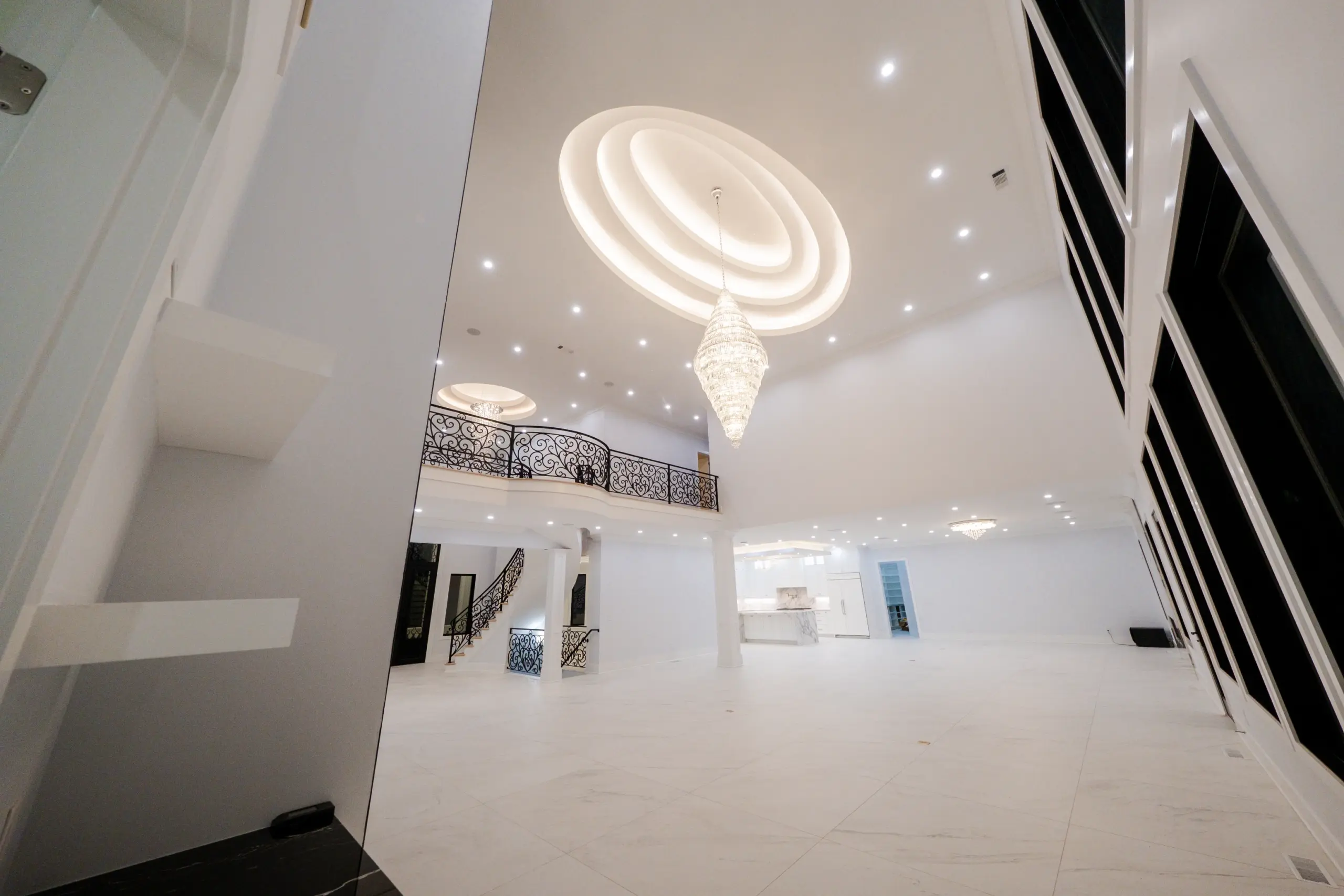
The foyer chandelier visible from the open mezzanine — the vertical sightline that makes this home feel designed at every level
The entry foyer functions as the organizational spine of the main floor. The kitchen and living areas extend to one side, the formal dining to the other. The staircase rises from within the foyer, making it visible from both the entry and the living areas. This arrangement puts the home’s most dramatic architectural element — the two-story volume with the spiral chandelier — at the intersection of every primary circulation path, ensuring that it is seen and experienced constantly rather than only when someone arrives at the front door.
The kitchen was placed to take advantage of the natural light from the rear of the lot while maintaining a sightline to the foyer that allows the cook to see into the entry. This is a practical luxury that is frequently overlooked in floor plan design — the person spending the most time in the kitchen should be able to see who is arriving at the front door without leaving the cooking zone.
Does an open-concept floor plan affect acoustics in a custom home?
Yes. Open volumes allow sound to travel more freely than compartmentalized rooms. On this home, the ceiling treatment in the living area — the coffered ceiling with its geometric forms — helps scatter and absorb sound rather than allowing it to reflect off a flat ceiling. Area rugs, upholstered furniture, and window treatments in the principal rooms provide additional acoustic dampening.
Is open-concept design harder to heat and cool efficiently?
A two-story open volume requires careful HVAC zoning to maintain comfortable temperatures at both floor levels. This home uses a multi-zone system with separate thermostats for the main floor and upper level, and the HVAC design was planned in coordination with the architectural design — not added as an afterthought after the floor plan was finalized.
Serving Gwinnett, Forsyth, Hall, Fulton, and Cherokee County homeowners within 30 miles of Duluth, GA.
Request a ConsultationAtlantic Construction & Remodeling — custom luxury home design and build serving the north Atlanta metro within a 30-mile radius of Duluth, GA.